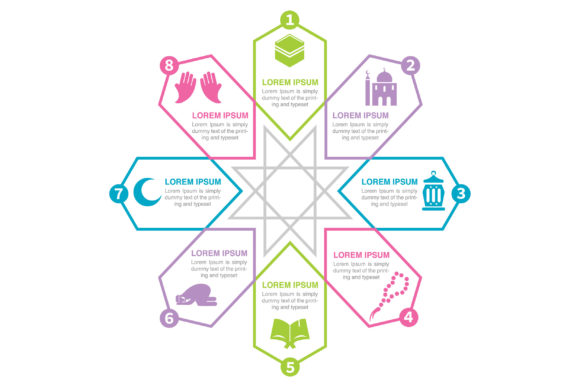
Islamic Infographic: Graphics & Infographics for Creative Sellers
As someone who’s launched over 200 digital product listings across Etsy, Creative Fabrica, and Shopify—mostly printable designs, Canva templates, and sublimation-ready assets—I opened Islamic Infographic expecting a clean, culturally grounded visual tool. What I found was a tightly composed, vector-based graphic design asset that balances reverence with versatility. It doesn’t shout—it invites. The mood is calm and intentional: elegant but not ornate, modern without losing traditional rhythm in its line work and spacing. It leans into quiet confidence—not festive or playful, not minimalist to the point of sterility, but thoughtfully decorative. That makes it ideal for buyers seeking dignity and clarity: educators creating classroom resources, Muslim small business owners building brand identity, wellness coaches designing Ramadan planners, or faith-based content creators needing respectful social media graphics.
This isn’t clipart you drop into a greeting card and call it done. Islamic Infographic is built as a true commercial design: vector-based, fully editable, infinitely scalable without pixelation, and delivered in both AI and EPS formats. Every element—from geometric borders to stylized Arabic-inspired motifs—is layered and labeled, making selective edits fast. No raster traps, no hidden bitmap fills. That means when you export for SVG use (Cricut, Silhouette), PNG design (stickers, planner elements), or high-res print (wall art, nursery prints), you’re starting from a stable, professional foundation—not a flattened mess you’ll spend hours ungrouping.
In practice, I tested Islamic Infographic across six real product types before finalizing a listing: printable Ramadan wall art, a Canva template pack for Islamic school newsletters, a tumbler wrap bundle for print-on-demand, SVG cut files for Cricut users, a digital paper pack with coordinating patterns, and Instagram story templates for mosque outreach teams. It held up consistently—especially where visual hierarchy matters. On mockups, it added instant credibility: the clean lines translated well to mug designs, the balanced negative space made planner stickers feel premium, and the scalable vectors scaled cleanly into large-format wall art previews. For Etsy product thumbnails, it stood out without clutter—its restrained color palette and clear focal point helped boost click-through in search results dominated by busy, low-contrast designs.
Where Islamic Infographic shines most is in themed bundles and brand-aligned collections. I paired it with a serif font for formal invitations, a warm sans serif for digital downloads, and a subtle script for seasonal greeting cards—and each combination felt cohesive, not forced. It also works exceptionally well in product mockups: the vector clarity meant crisp shadows and realistic fabric drapes on tote bag previews, and smooth gradients on sublimation mug renders. As part of a larger design bundle—say, alongside halal-certified label templates or Quran journal icons—it strengthens perceived value and supports consistent small business branding.
That said, it’s not universally plug-and-play. I recommend caution in three areas. First, avoid using it for tiny sticker details—some fine linework loses definition under 0.25” scale, especially on dark backgrounds. Second, don’t force it into text-heavy Canva templates where dense layout competes with its visual breathing room; it’s strongest when given space. Third, test SVG cut quality early: while the vectors are clean, overlapping paths in certain motifs required minor pathfinder cleanup before sending to Cricut Design Space. Also verify contrast against your intended background—some lighter gold tones fade on cream packaging or off-white mugs unless adjusted in CMYK preview.
Before publishing any finished product, here’s my checklist—refined over years of launching digital download shops:
- Preview the AI file at 100% zoom to confirm all layers are unlocked and editable
- Export a PNG at 300 DPI and check transparency—no stray white pixels around edges
- Test an SVG export on Cricut Design Space: run a “cut preview” to spot unintended compound paths
- Drop the design onto white and charcoal mockups to assess contrast and legibility
- Print a physical sample on your target paper stock—some gold or teal tones shift subtly on matte vs. glossy finishes
- Review the commercial license carefully: confirm you’re cleared to sell end products (t-shirts, mugs, digital downloads) without attribution
- Organize customer files clearly—label AI/EPS/SVG/PNG versions separately, include a brief usage guide
For creative entrepreneurs, Islamic Infographic isn’t just another graphic—it’s a strategic piece of visual infrastructure. It supports multiple revenue streams: as a standalone printable design, as part of a seasonal bundle (Ramadan, Eid, back-to-school Islamic studies), as a foundational element in Canva template kits, or as a refined graphic for handmade business packaging design. Its strength lies in flexibility without compromise: it’s respectful enough for faith-based contexts, polished enough for premium digital marketplaces, and technically sound enough to scale from social media graphics to large-format wall art.
If you’re curating a collection for Etsy or preparing a new line for print-on-demand, treat Islamic Infographic like a reliable collaborator—not just a decoration. Test it early, pair it intentionally, and let its quiet precision do the work of building trust, consistency, and visual authority across your entire product range.